Train Dream
Train DreamsTrain dreams are a recurring memory-pattern in Robert Grainier’s life, linking the railway of his working world with the forgotten train ride that began his childhood. They do not merely interrupt his sleep. They make time unstable, return him to experiences he cannot consciously recover, and place private grief beside the vast historical movement of machines, towns, and modern travel.
Origins in Childhood
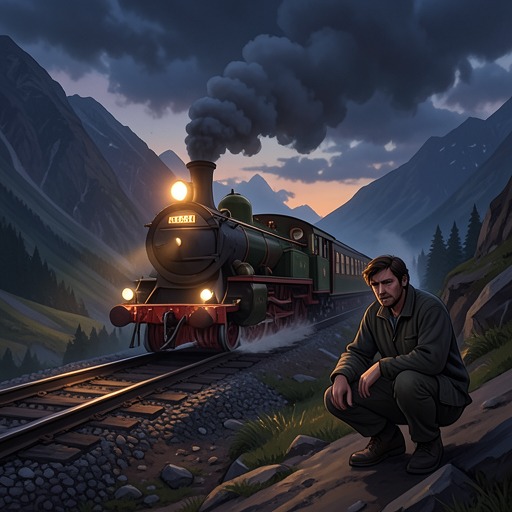
The train dream is first associated with the beginning of Grainier’s life story. As a child, he was sent alone to Idaho by train, but he never learned from precisely where he had been sent, and nobody told him how he had lost his original parents. His cousins disagreed about their relationship to him and could agree only that he had arrived on a train. The journey therefore survives not as a complete recollection but as an opening surrounded by missing facts. In later dreams, the train carries the emotional force of a lost origin: it moves through a world that feels familiar without becoming fully knowable.
The uncertainty is intensified by Grainier’s lifelong tendency to confuse chronology. He could recall one particular moment on one particular night for his entire life, yet other parts of the past shifted in memory. In old age, he became convinced that the day he saw the World’s Fattest Man was the same day he heard about Elvis Presley’s private train stopping in Troy, Montana, twenty-six miles east of the bridge he had helped build, although the account explicitly presents this as a confusion of chronology. His remembered life began on a train ride he could not remember and ended with him standing outside a train containing a famous young entertainer he never actually saw. Train imagery thus frames his existence while withholding a stable, orderly account of it.
The Dreams After the Fire
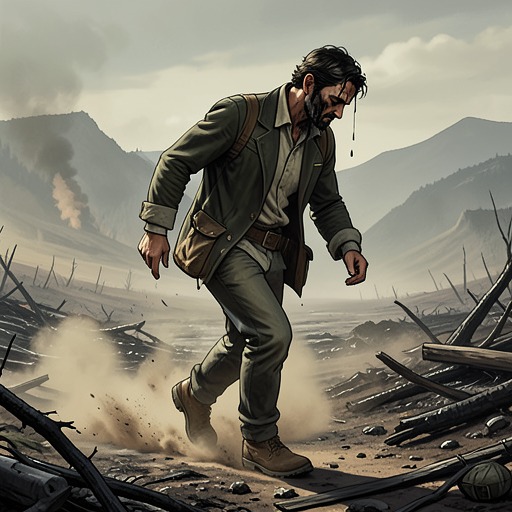
After the Moyea Valley fire destroyed his home and apparently killed Gladys Grainier and Kate Grainier, Grainier’s dreams first became an extension of mourning. He stayed with his cousin for several weeks, unable to settle the fact of their deaths because the hope that they had escaped kept returning with overwhelming force. Nightmares showed Gladys emerging from the blackened landscape in smoking rags, carrying their daughter, finding nothing left on the homesite, and crying in the waste. The fire entered sleep as a scene of return that could never become a reunion.
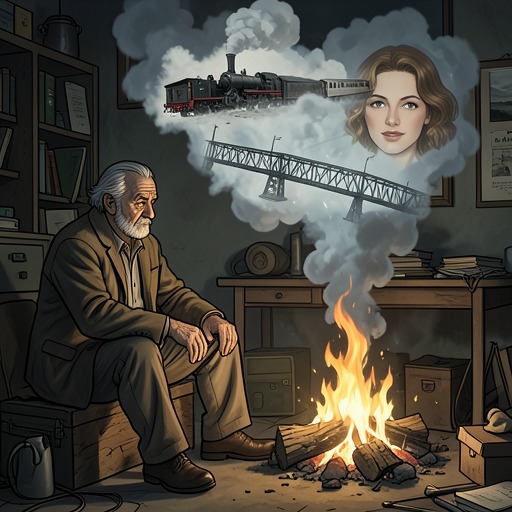
In the first months of his widowerhood, Grainier kept a campfire burning as late as possible because he feared his dreams. At first he dreamed of Gladys and Kate, then only of Gladys, and finally only of the fire itself. His nightly attention to the actual fire and his dream of tending it became indistinguishable: he watched the flames through the night in sleep, only to wake and find gray ash and charred ends of lodgepole. The dream repeated the practical gesture of maintaining warmth while exposing the impossibility of preserving what the fire had taken.
Return to the Railway World
Three years after the fire, Grainier lived in a second cabin built precisely where the old one had stood. By then he slept soundly, and his dreams often contained trains. In the recurring scene he was aboard one, smelling coal smoke as the world moved past; then he stood in that world while the train’s sound faded away. A weak but persistent familiarity suggested that these scenes came from childhood. At times the locomotive of the Spokane International passed in waking life while he dreamed, and its receding sound became part of the dream’s evidence.
One December night during his second winter in the new cabin, such a dream woke him. The train continued north until he could no longer hear it, and the prospect of becoming a child again in the other world terrified him so thoroughly that he could not return to sleep. The cabin had acquired the material signs of a home—proper roofing, windows, two benches, a table, and a barrel stove—yet Grainier and the red dog still slept on a pallet on the floor. The train dream therefore carried him backward from a hard-won domestic present into the unresolved condition from which his life had begun.
The dream also summons Gladys. After the train’s sound disappears, Grainier senses her moving through the cabin before seeing her. The red dog remains silent but raises the hair along her back as a quavering light gathers and takes the form of a woman. The apparition becomes Gladys, flickering and false like a motion-picture figure. The visitation does not restore the lost household; instead, it shows how the railway dream, the burned home, and the dead wife have become interlocked within Grainier’s perception. Gladys never appears to him in spirit form again, though he continues to dream of her and of the flames that killed her, often waking amid a sound that is both the thunder of fire and the Spokane International traveling up the valley.
Dream, Flight, and Modern Time
The train dreams belong to a larger pattern in which new technologies open temporary passages into concealed memory. In 1927 Grainier paid four dollars to ride in a biplane at a county fair, despite his fear of the frail-looking wings and his inability to understand how a machine whose wings stayed still could fly. During the flight, after the craft rose and then plunged, he saw the summer evening when he, Gladys, and Kate drank Hood’s Sarsaparilla in their cabin. He also saw a cabin he had never remembered before, a golden wheat field, a road shimmering in heat, arms around him, and a woman’s crooning voice. The airborne vision answered mysteries of his life only for the duration of the descent; when the engine roared and the plane leveled, the present world returned.
The contrast between the biplane and the train is important. The plane produces a sudden, violent release of buried images, while the train provides a repeated route through memory, carried by coal smoke, mechanical sound, and the gradual movement of a world outside the window. Grainier’s life also includes regular train travel, many automobile rides, one aircraft flight, later cinema, and television during his final decade. Yet technological change never simply replaces older experience. The train remains the medium through which childhood, grief, and the soundscape of the valley return.
Meaning and Final Resonance
Train dreams preserve a life that official chronology cannot fully organize. Grainier helps build the Eleven-Mile Cutoff Bridge, watches its first locomotive cross the 112-foot span over a 60-foot-deep gorge, and later hears locomotives moving through the valley as he sleeps. The railway is therefore both labor and hallucinated passage, a public infrastructure and a private archive. Its trains connect towns and shorten routes, but in Grainier’s consciousness they also carry him toward the unrecorded beginning of orphanhood and away from the irrecoverable scenes of family life.
Their recurrence makes memory less a storehouse than a landscape through which Grainier repeatedly travels. The dream train brings back a childhood he cannot narrate, while the waking railway accompanies the fire’s aftermath, the apparition of Gladys, and the ordinary nights of his solitary cabin. Even when he lives more than eighty years and witnesses the arrival of aircraft, automobiles, film, television, and Elvis Presley’s railway celebrity, the earliest train remains the most mysterious vehicle in his life. It represents movement without explanation: a departure whose destination is known only through the fragments that return.